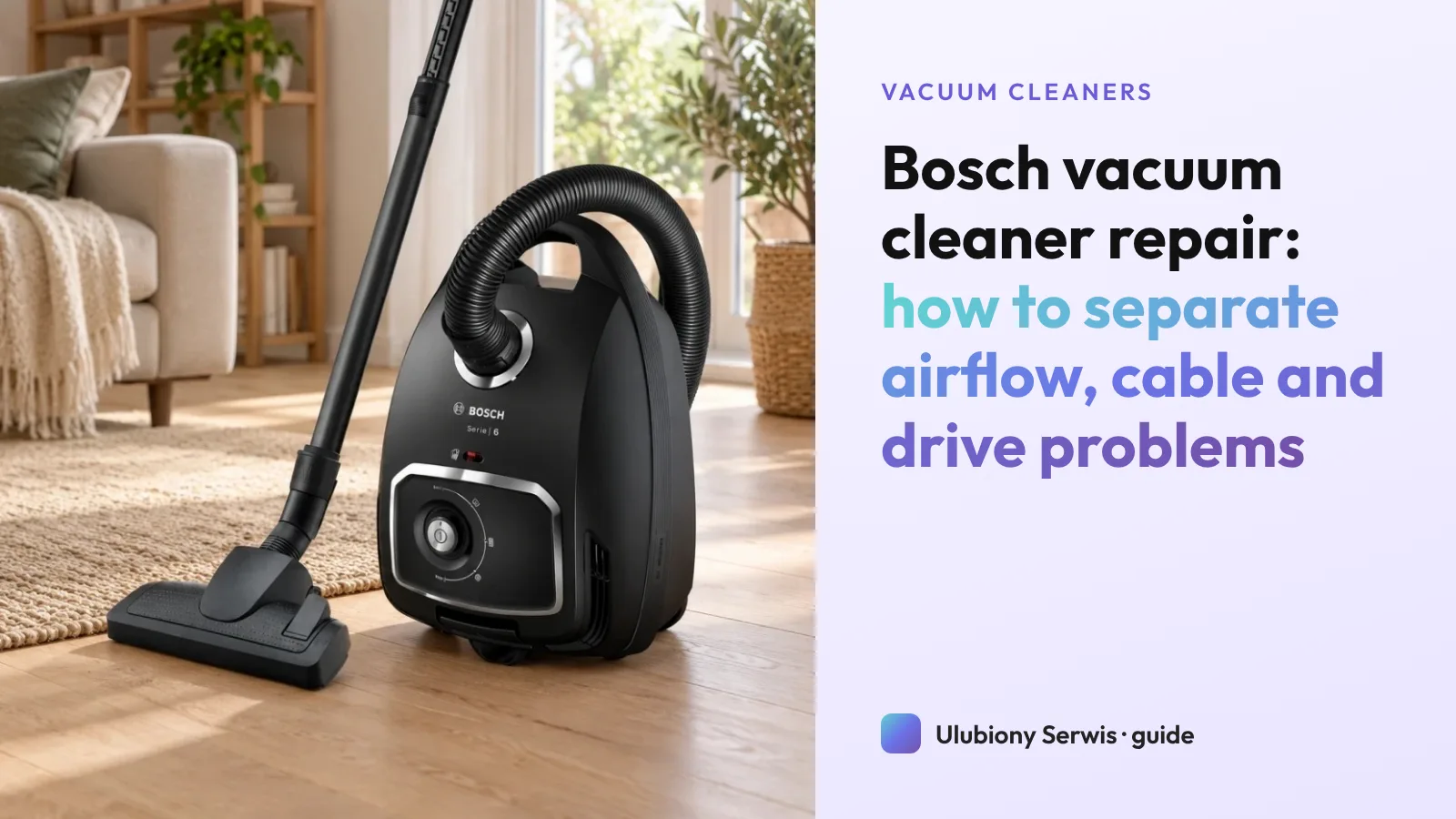
Bosch vacuum cleaner repair: how to separate airflow, cable and drive problems
The short answer
IN BRIEF A Bosch vacuum cleaner repair depends on the specific design. In a corded model, no power may point to the cable, cable reel or motor, and in a cordless stick vacuum to the battery, charger and electronics. In both cases, reduced suction is checked starting with filtration, airflow and seals. The full model number allows us to choose the right tests and avoid ordering parts based on the brand alone.
What the user sees
Note whether the device is corded or cordless, whether the symptom occurs without the tube and whether the brush head has its own drive.
- the vacuum cleaner does not respond or cuts out during use;
- suction is weak even though the bag and filters have been maintained;
- the motorised brush head does not turn;
- the cordless model does not charge or switches off quickly;
- the device is noisy or gets hot under load.
What you can safely check
- confirm the full model number;
- check the bag or bin, filters, tube and brush;
- inspect the cable or charger without opening the casing;
- compare the behaviour with and without accessories, if the manual allows this.
What could be the cause
The brand covers many designs, so the possible causes have to be matched to the power type and the specific symptom.
- a blockage, filter problem or leak;
- a fault in the brush, cable or a connection;
- a problem with the cable, cable reel, battery or charging;
- a worn motor or bearings;
- a fault in a sensor or the control electronics.
When to stop using it
SAFETY Unplug the device if the cable is damaged, there is sparking, a burning smell, a swelling battery or unusual overheating. Do not use an unverified charger.
Does a repair make sense?
A single fault in a complete vacuum cleaner usually makes the decision clear. If several parts are worn, the quote should take into account the motor, power supply and availability of accessories.
DECISION RULE We compare the full cost with a device with similar functions. A single confirmed fault and the good condition of the other assemblies speak in favour of a repair; several independent faults require further assessment.
How the repair works
- identification of the design and the items needed;
- an airflow and airtightness test;
- a check of the power supply, drive and electronics;
- a check of operation under real load after the repair.
What to include in your request
- the full model from the rating plate and, where applicable, the designation of the station, power adapter or accessory;
- a description of when the main symptom occurs: the vacuum cleaner does not respond or cuts out during use;
- a short video of the whole scenario, a photo of the message and of the parts needed to reproduce the fault;
- whether the symptom is constant or intermittent, and what happened immediately before it appeared;
- the history of previous repairs, water damage, power surges, drops or use of an incompatible accessory.
FAQ
Does the suffix of the model number matter?
Yes. It may indicate a different version of a part or configuration, so copy the full designation from the rating plate.
Should I send the brush head together with the main unit?
Yes, if it does not turn or the device cuts out when it is attached. It is then part of the test.
Can weak suction be caused by a leaking tube?
Yes. A leak or a blockage can have a similar effect, so both are checked before the motor is assessed.
Next step
Give us the full Bosch model and power type. Tell us whether the symptom changes when the tube or brush head is removed.