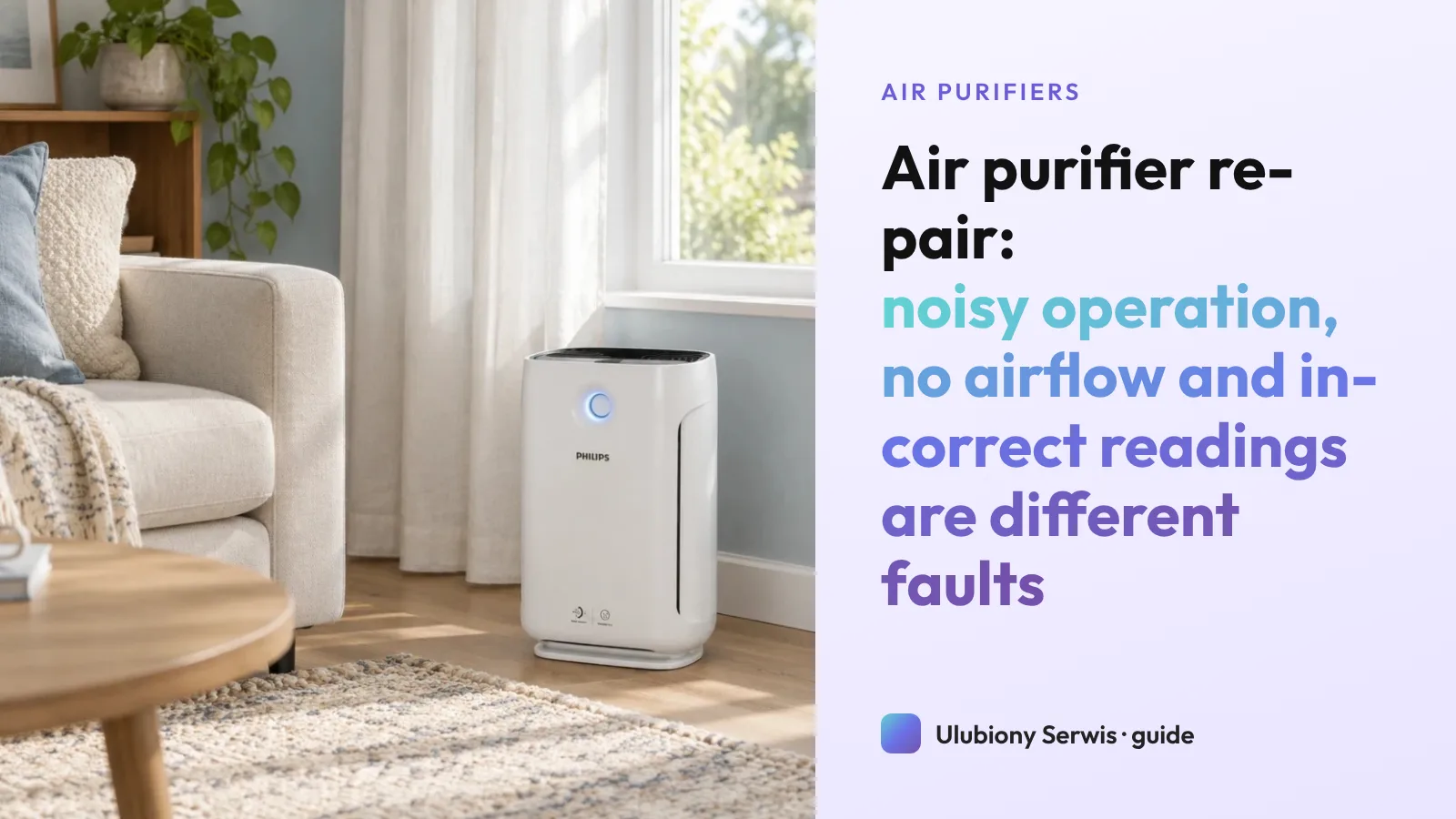
Air purifier repair: noisy operation, no airflow and incorrect readings are different faults
The short answer
IN BRIEF An air purifier needs repair when correct maintenance of the filter and inlets does not fix a lack of airflow, loud operation, vibration or incorrect readings. The sensor may need cleaning as described in the manual, but unstable readings can also be caused by the fan, power supply or electronics. Do not use the device if there is a burning smell or the cable is damaged.
What the user sees
Separate the quality of the reading from the airflow. A purifier may blow properly but measure incorrectly, or the other way round - show readings but provide no airflow.
- the fan does not start or works on only one speed;
- the device vibrates, rubs or makes increasing noise;
- the air quality reading is constantly extreme or jumps sharply;
- the purifier resets or switches off;
- odours remain despite the correct filter and a clean device.
What you can safely check
- check that the filter fitted is the correct model and type;
- remove packaging and obstructions from the inlets and outlets;
- clean an accessible sensor only as described in the manual;
- record the sound at several speeds and note how the indicator behaves.
What could be the cause
The filter affects airflow, but it does not explain every fault. A technician should assess the fan mechanics, power supply and the reliability of the sensor signal.
- an incorrect, worn or badly fitted filter;
- a blocked inlet or outlet;
- wear of the fan, bearing or mounting;
- a dirty or faulty sensor;
- a problem with the power supply, panel or electronics.
When to stop using it
SAFETY Unplug the device if there is a burning smell, sparking, a damaged cable, violent vibration or liquid has got inside. Do not spray cleaning products into the inlets.
Does a repair make sense?
A repair makes sense for a purifier of good value when the filter is available, the casing is complete and the fault concerns one assembly. If filters are unavailable and both the fan and electronics are damaged, the balance may be unfavourable.
DECISION RULE We compare the full cost with a device with similar functions. A single confirmed fault and the good condition of the other assemblies speak in favour of a repair; several independent faults require further assessment.
How the repair works
- an airflow test at several speeds and a vibration check;
- a check of the filter, inlets and fan mechanics;
- comparison of the sensor reading under controlled conditions;
- a final check of noise, airflow and operating stability.
What to include in your request
- the full model from the rating plate and, where applicable, the designation of the station, power adapter or accessory;
- a description of when the main symptom occurs: the fan does not start or works on only one speed;
- a short video of the whole scenario, a photo of the message and of the parts needed to reproduce the fault;
- whether the symptom is constant or intermittent, and what happened immediately before it appeared;
- the history of previous repairs, water damage, power surges, drops or use of an incompatible accessory.
FAQ
Will replacing the filter fix a noisy purifier?
It may reduce airflow resistance, but it will not fix a worn bearing, a rubbing fan or a loose mounting.
Can the sensor be blown clean?
Only using a method explicitly approved in the manual. Too strong a jet of air can damage a delicate component or force dust inside.
Should I send the filter to the repair service?
If the symptom concerns airflow, noise or readings after the filter has been fitted, the filter may be needed to recreate the conditions. Confirm what to send.
Next step
Give us the brand, model, filter type and main symptom. Attach a sound recording or a photo of the unstable reading.