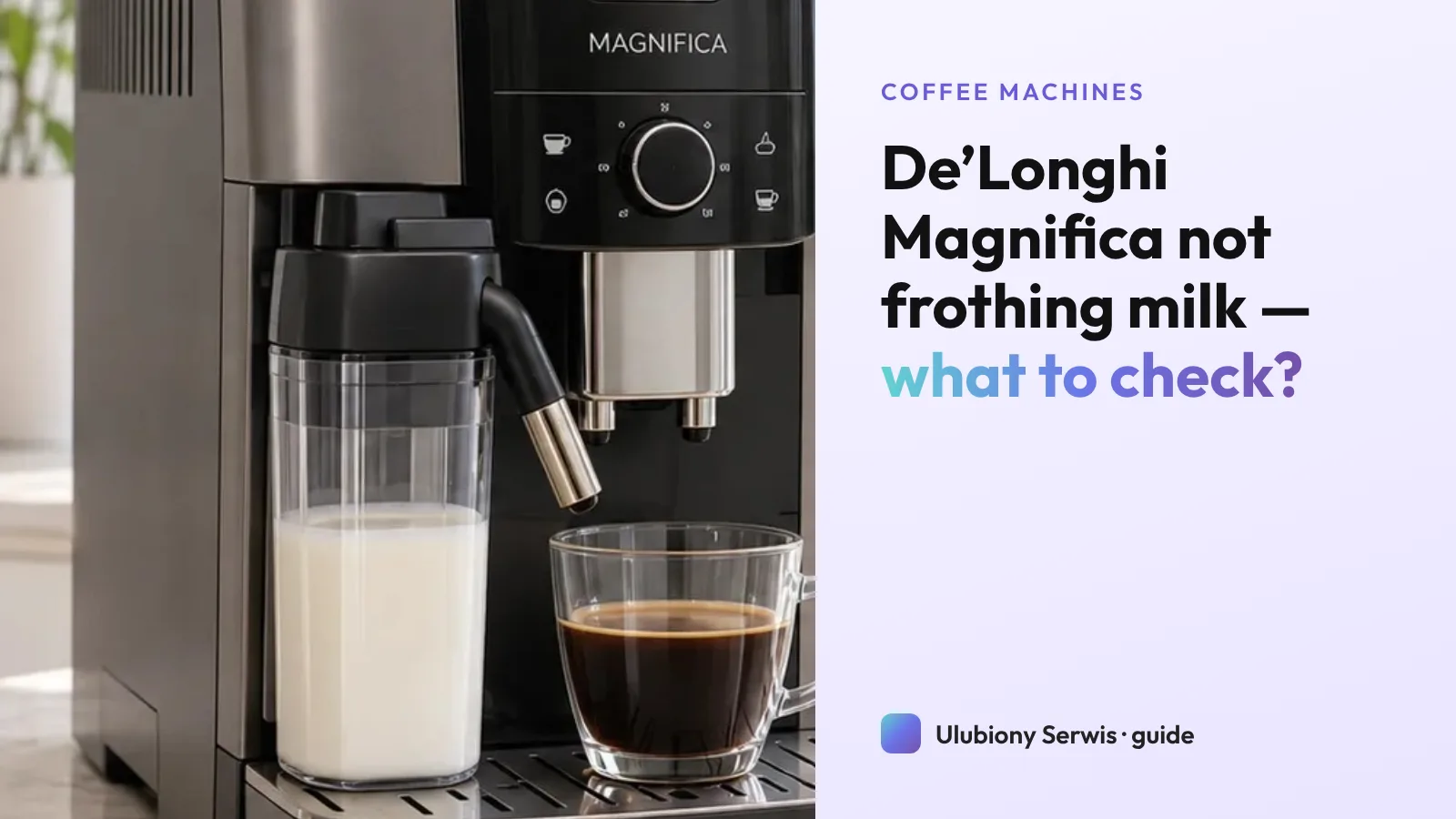
De’Longhi Magnifica not frothing milk — what to check?
The short answer
IN SHORT When a De’Longhi Magnifica stops frothing milk, first check what you can do yourself: dried milk in the steam nozzle tip or in the jug, incorrectly assembled parts and the milk itself. If, after thorough washing and correct assembly, no steam comes out of the nozzle, only water comes out, or the jug doesn't draw up milk, the steam system needs to be diagnosed by a repair service.
What the user sees
The Magnifica range comes in versions with a manual steam nozzle and versions with an automatic milk system (jug). The "not frothing" symptom looks different in each, so before you request a repair, work out which of the descriptions below matches your coffee machine.
- steam comes out of the nozzle, but the milk only heats up, with no froth;
- hot water comes out of the nozzle or the steam "spits" droplets;
- nothing comes out of the nozzle when you select the steam function;
- in the jug version, the milk stays in the container and isn't drawn up;
- the froth is thin, with large bubbles, and collapses quickly;
- the symptom returns shortly after thorough cleaning.
What you can safely check
The steps below do not require opening the housing. Wash and assemble the parts (steps 1–2) with the coffee machine switched off and cooled down. The milk test, steam test, descaling and recording the cycle (steps 3–6) require the machine to be switched on — keep your hands away from the nozzle, as steam and hot water can scald. Follow the user manual for your model.
- Steam nozzle tip (manual frothing versions) — remove the outer frothing tip, wash it in warm water and check that the holes aren't blocked with dried milk.
- Milk jug (milk system versions) — take it apart into the parts shown in the manual, wash the suction tube and lid, then check that the jug is pushed fully into its slot on the machine.
- The milk itself — use cold milk straight from the fridge. Plant-based drinks and milk with a different fat content can produce completely different froth, so for the test choose the milk that used to froth well.
- Steam without milk — place an empty container under the nozzle and turn on the steam. Check whether it comes out in a steady stream or intermittently or with water.
- Descaling — if the machine indicates that descaling is needed, do it with a product designed for coffee machines and only then assess the frothing.
- Recording — record one full frothing cycle from start to finish. A video like this makes the initial assessment much easier.
Regularly washing the milk parts is the simplest prevention. If the deposits are deeper in the system, professional coffee machine cleaning can help.
What not to do
SAFETY Stop testing if steam escapes from the side, water leaks from under the housing or parts of the jug or nozzle are cracked. Steam and hot water can scald.
- do not drill out or widen the holes in the nozzle tip or the jug parts — this changes the ratio of air to milk;
- do not open the housing or unscrew parts that the manual does not tell you to remove;
- do not use random chemicals, vinegar or harsh detergents — only products designed for coffee machines;
- do not put parts in the dishwasher unless the manual says they are dishwasher-safe;
- do not keep turning on the steam "to test it" when nothing comes out of the nozzle or the machine shows an error message.
What could be the cause
On the technical side, three areas need to be separated: whether the milk path is clear and sealed, steam generation, and the controls. Each of them is checked with a different test.
- dried milk in the nozzle tip, the suction tube or the jug channels;
- a leak — a cracked or worn seal, or a badly seated jug;
- limescale restricting flow in the steam system;
- a heating problem — the steam is too wet or too weak;
- a faulty valve, sensor or control electronics.
We also describe the same symptom for other brands — see what to check when a Melitta isn't frothing milk, and our guide to a Nivona coffee machine that isn't frothing milk.
From the workshop
This is how our technician sees this fault:
In Magnificas with a milk jug, the most common cause is limescale building up in the hoses of the water system. This leads to a typical solenoid valve fault — the plunger that moves inside its coil seizes. The result: no flow, and the machine stops delivering milk from the jug. The electronics rarely fail, and when they do, it is usually together with the heating element — the machine then delivers only cold water.
The difference between the versions is considerable. In the jug version, the solenoid valve redirects the steam and water needed for frothing, so if it fails, all milk-based coffees are blocked. Versions with a manual nozzle don't have this solenoid valve; their system is simpler and they break down less often. What remains are mechanical faults: limescale blocking the water flow to the boiler (the heating element that heats the water; steam is produced by a separate heating element), a cracked seal that doesn't hold pressure during frothing and, very rarely, a broken nozzle. The jug version is more convenient, though: you make a milk coffee with one button on the screen.
When to send it for repair and what happens
Request a repair if, after washing, correctly assembling the parts and testing with fresh, cold milk, there is still no steam from the nozzle, mostly water comes out, the jug doesn't draw up milk or there is a leak somewhere. If the other functions — grinding, brewing, coffee temperature — work properly, repairing just the milk path is usually a sensible decision. If there are several independent faults, our guide on when a repair makes sense will help.
Submitting a request via the repair form does not commit you to a repair. Based on the model and the description of the symptoms, we prepare an initial assessment, and once you accept the quote we arrange an insured courier pickup. The technician reproduces the symptom, and if the scope or cost of the repair were to change, we contact you before going ahead.
- initial quote: 0 zł; pickup to the repair service after accepting the quote: 0 zł;
- diagnosis with repair: 0 zł; 150 zł if you decline the repair, or in case of water damage or a power surge;
- typical repair time: 2–5 business days from receipt of the device — parts availability may extend it;
- insured return shipping: 25 zł (up to 1500 zł in value) or 45 zł (up to 5000 zł);
- warranty: 12 months for private customers for a repair with parts replacement, 3 months for a repair without parts replacement, 6 months on batteries and for businesses.
Details are set out in our warranty and insurance terms. You will find the full range of supported models and faults on the De’Longhi coffee machine repair page.
What to include in your request
- the full model from the rating plate and whether the machine has a manual steam nozzle or a milk jug;
- which symptom from the list above fits best and whether it is constant or intermittent;
- a short video of one frothing cycle and a photo of any message on the display;
- the history of previous repairs, water damage, power surges or drops.
FAQ
Does no froth always mean a fault?
No. Often all it takes is thoroughly washing the nozzle tip or the jug, assembling the parts correctly and using cold milk. If that doesn't help and the steam is weak, wet or doesn't come out at all, the cause is usually deeper and needs a diagnosis.
Water instead of steam comes out of the nozzle — what does it mean?
A first portion of water right after turning on the steam can be normal. However, if water flows throughout the cycle, the steam isn't reaching the right temperature or the flow is disrupted. Don't test it repeatedly — report the symptom with a video.
Will descaling again help?
It is worth descaling according to the manual if the machine needs it. If the symptom persists despite correct descaling and clean milk parts, repeating it usually won't fix a valve, heating or sealing fault.
Should I send the coffee machine together with the milk jug?
Yes, if your model has one. The technician needs to reproduce the symptom on the complete set you use every day.
Next step
In your request, indicate whether no steam comes out of the nozzle, whether there is steam but no froth, or whether the jug doesn't draw up milk. Give the model and attach a video of one frothing cycle.