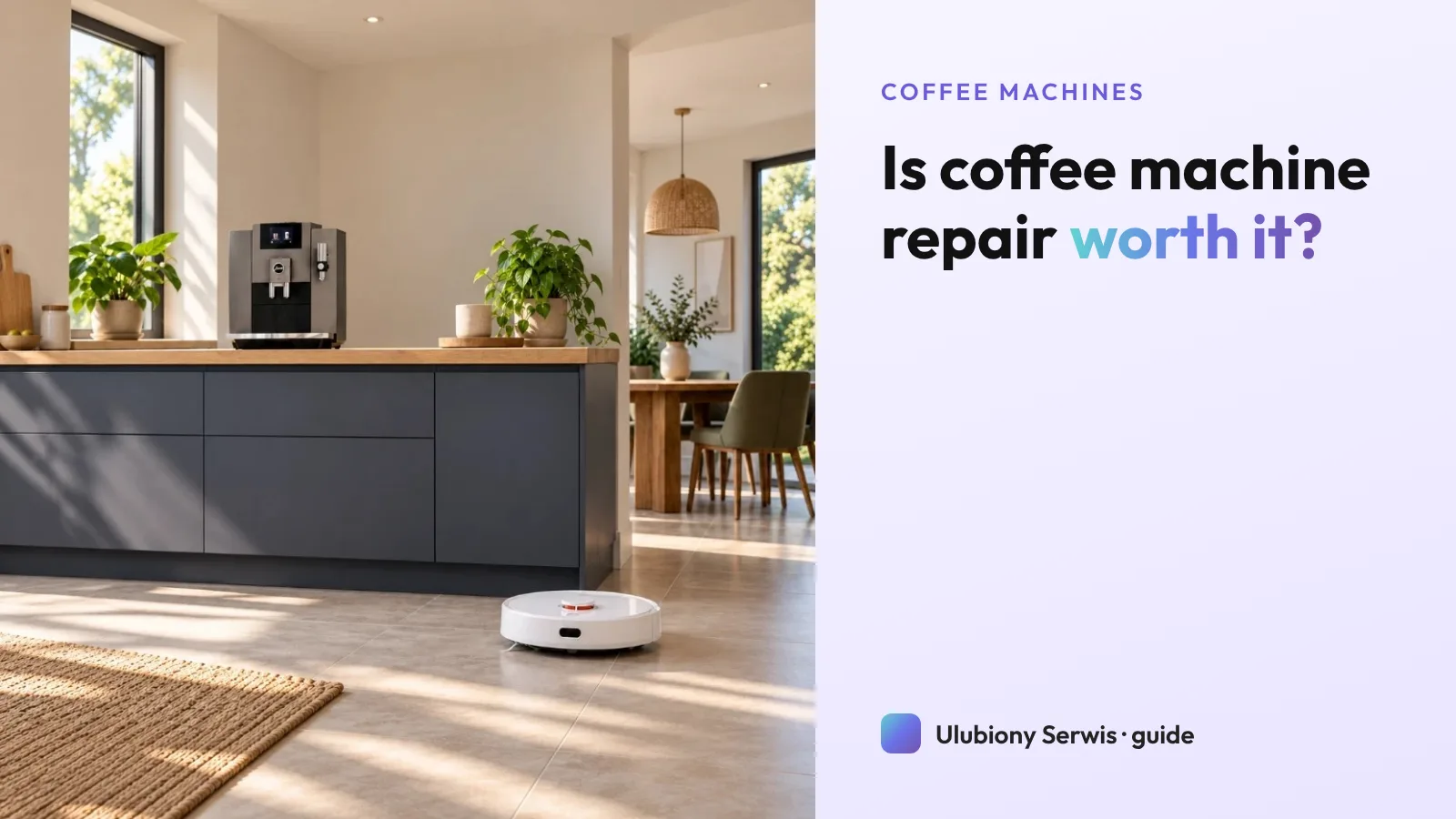
Is coffee machine repair worth it?
In our workshop we hear the same key question every day: "Is it still worth repairing my coffee machine?" To give you a concrete, fact-based answer, we are taking you behind the scenes. Your guide is Wiktor – our Senior Technician with more than 10 years' experience, who has brought tens of thousands of devices back to life.
From our repair practice: more than 8 out of 10 coffee machine repairs are successful. However, this does not mean that every repair is worth it – that is decided by a separate rule: the cost of the repair should not exceed 40% of the value of a new machine of the same class. The key is a professional diagnosis and understanding when the investment makes sense and when it only puts off the inevitable.
- More than 8 out of 10 repairs are successful, especially for typical wear-related faults.
- Apply the "40% rule": Don't invest in a repair if it costs more than 40% of the value of a new coffee machine of the same class.
- Compare wisely: Compare the value of the machine being repaired with its present-day equivalent, not with the cheapest model on the market.
- Demand standards: A professional repair service must offer a transparent diagnosis, safe logistics, verified parts and a warranty.
Is a coffee machine repair worth it, and where is the cost-effectiveness limit?
From the perspective of the workbench, the statistics are clear: more than 8 out of 10 repairs end in complete success, with a machine that will serve for years to come. The role of a professional repair service is not only to be a technician but, above all, an honest adviser.
The cost-effectiveness limit is determined by maths based on three parameters: the age of the device, its current market value and the cost of parts.
If the repair is estimated to cost more than 40% of the value of a new coffee machine of the same class, the investment becomes risky. Repairing a machine for 900 zł when its new equivalent costs 1400 zł is simply not fair. There is a risk that another expensive component will wear out in a few months, and the customer's frustration would be fully justified.
Why is comparing with "the same class" so important?
This is the most common mistake in assessment. Customers compare the cost of repairing their 6-year-old premium coffee machine with the cheapest model from a supermarket. A good-quality coffee machine a few years old, with a steel grinder, has much greater value and potential after a professional repair than the cheapest new model. Always compare like with like.
Safe bets: faults that are almost always worth repairing
Most breakdowns result from natural wear and tear. The scenarios below are our "safe bets", where repair is almost always the best solution.
| Typical fault | Why is the repair worth it? |
|---|---|
| Loud operation or no grinding | In 9 out of 10 cases, it is down to worn burrs or a blocked grinder. Replacing just the burrs costs around 20–30% of the value of a new coffee machine and restores 100% of its functionality. |
| Water leaking from under the machine | This is most often a sign of worn seals (O-rings). It is a quick, inexpensive repair that is absolutely essential to protect the electronics from water damage, which would be far more costly. |
| Cold or weak coffee | This usually indicates a problem with the heating element or a clogged circuit. Replacing these standard components in a 3–6-year-old machine is fully justified and gives it a second life. |
Red flags: when should we advise against a repair?
Apart from exceeding the cost-effectiveness threshold, there are two main "red flags" where even the greatest optimism has to give way to common sense.
- Critical mainboard damage
Serious water damage or a power surge often causes micro-damage to the control module. Even after repair, the electronics may remain unstable. An honest repair service should inform you of this risk. - Over 10 years old and no original (OEM) parts
A professional repair service uses only verified and proven replacement parts, because otherwise it cannot back them with a warranty. If the manufacturer no longer supports the model, the repair becomes more difficult.
The repair standard you should expect
Deciding whether it is worth it is one thing. The other is being sure that the repair will be carried out professionally. Here are 4 stages that define the quality of a good repair service:
- Transparent diagnosis and cost estimate. The gold standard is a free diagnosis if you go ahead with the repair. Nobody has the right to start work without your approval of the cost estimate.
- Safe logistics. The repair service should arrange and insure door-to-door transport. Responsibility for the device lies with the repair service.
- Repair with verified parts. Professionalism means using only reliable, proven parts. This guarantees compatibility and durability.
- Quality control and warranty. After the repair, the coffee machine must pass tests (QC). It is also standard to give a warranty (at least 6 months) on the service carried out.
FAQ: Frequently asked questions
| Question | Answer |
|---|---|
| How does a repair service assess whether a repair is worth it? | The repair service bases its assessment on data: the age of the device, the cost of parts and the market value of a new equivalent. If the repair costs more than 40% of that value, we advise against it. |
| Why is it so important to repair a leaking coffee machine quickly? | A leak, most often caused by worn seals, is a direct threat to the electronics. A quick and inexpensive seal repair prevents a mainboard failure that would cost many times more. |