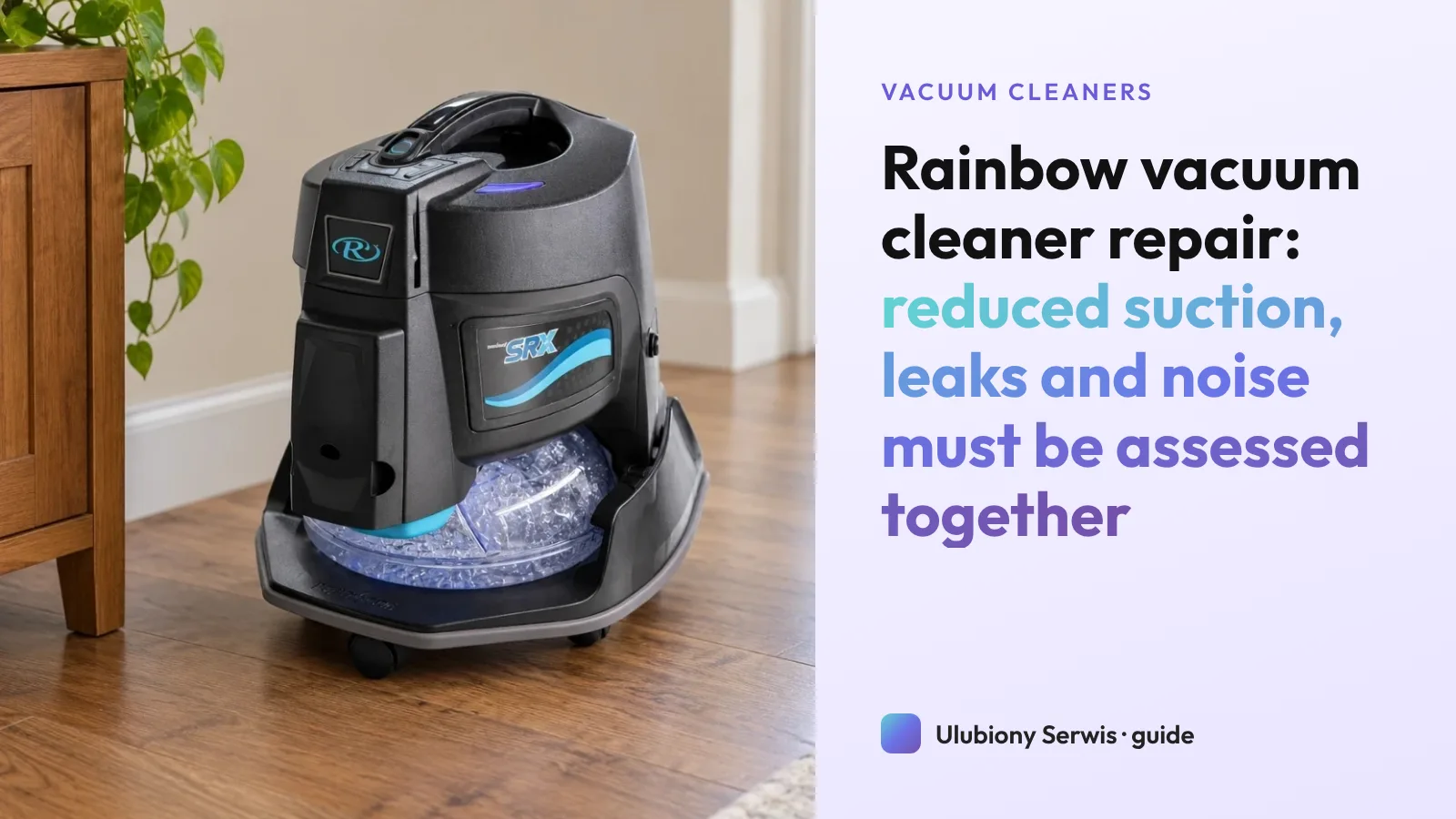
Rainbow vacuum cleaner repair: reduced suction, leaks and noise must be assessed together
The short answer
IN BRIEF A Rainbow vacuum cleaner repair requires a test in the complete configuration, because the water basin, separator, seals, hose and motor affect both airflow and safety. Weak suction can be caused by a leak or a blockage, and unusual noise by a rotating part or the drive. Water outside the basin, vibration and a smell of overheating mean you must stop using it.
What the user sees
In your request, it is worth stating whether the symptom occurs with an empty, correctly assembled test set-up and whether it changes when the hose is attached.
- suction has dropped even though the set is clean and correctly assembled;
- the device vibrates or makes an increasing noise;
- water appears outside the basin;
- the motor gets hot or switches off during use;
- the hose, a connection or an accessory clearly restricts airflow.
What you can safely check
- unplug the device and check that the basin and user-serviceable parts are seated correctly;
- inspect the accessible seals, hose and connections;
- do not run the vacuum cleaner with water outside the designated basin;
- record the sound of a short, safe trial run only if there is no leak.
What could be the cause
In a water filter model, the motor cannot be assessed in isolation from airflow and the completeness of the set. Diagnostics should recreate the real operating configuration.
- a leak in the basin, a seal or a connection;
- a blocked hose or accessory;
- an incorrectly seated or worn separator part;
- wear of the bearings, fan or drive;
- a fault in the power supply, a protective device or the motor.
When to stop using it
SAFETY Unplug the device immediately if there is water near the electrical parts, violent vibration, a metallic noise, a burning smell or a safety device trips. Do not tilt the set while it is running.
Does a repair make sense?
Given the value of the complete system, repairing a single confirmed fault may be sensible. Missing key parts, a damaged basin and simultaneous wear of the motor and separator require a full cost comparison.
DECISION RULE We compare the full cost with a device with similar functions. A single confirmed fault and the good condition of the other assemblies speak in favour of a repair; several independent faults require further assessment.
How the repair works
- a check that the set is complete and correctly assembled;
- a test of airtightness, airflow and rotating parts;
- an assessment of the motor and electrical safety;
- a final test in a configuration that matches actual use.
What to include in your request
- the full model from the rating plate and, where applicable, the designation of the station, power adapter or accessory;
- a description of when the main symptom occurs: suction has dropped even though the set is clean and correctly assembled;
- a short video of the whole scenario, a photo of the message and of the parts needed to reproduce the fault;
- whether the symptom is constant or intermittent, and what happened immediately before it appeared;
- the history of previous repairs, water damage, power surges, drops or use of an incompatible accessory.
FAQ
Is the main unit alone enough to diagnose a Rainbow?
Not always. For weak suction or a leak, the basin, separator, hose and parts that affect airtightness may be needed.
Does loud operation mean the motor?
Not necessarily. The source may be a rotating part, incorrect assembly, airflow resistance or a bearing. The sound has to be located.
How should I prepare the basin for shipping?
Empty it, wash it, dry it thoroughly and protect it as instructed by the repair service. Do not leave any water in the parcel.
Next step
Give us your Rainbow model and tell us whether the main symptom is suction, a leak or noise. We will confirm the list of items needed.