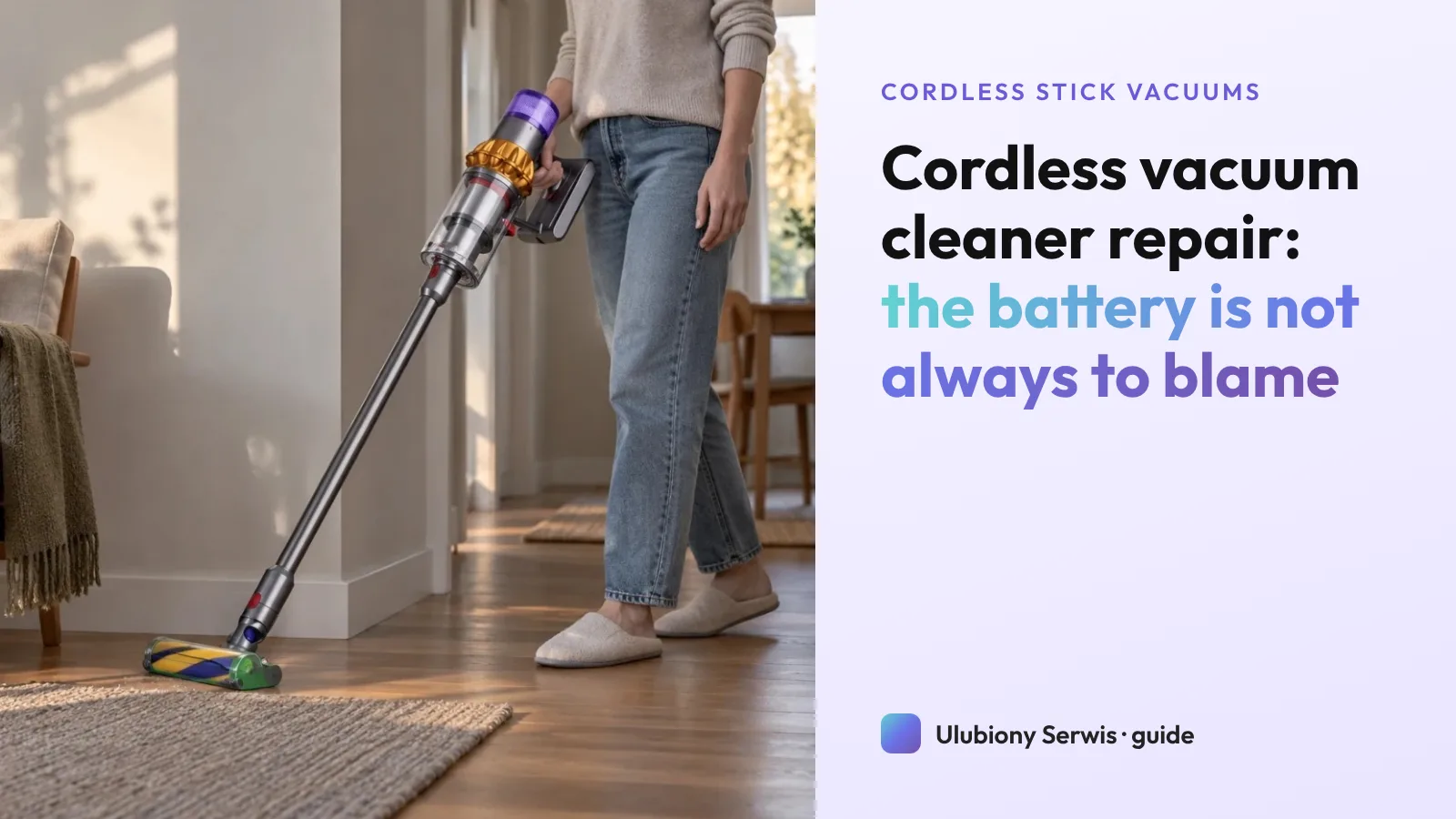
Cordless vacuum cleaner repair: the battery is not always to blame
The short answer
IN BRIEF In a cordless vacuum cleaner, a short runtime does not automatically mean a worn battery. Blocked airflow, a brush that is hard to turn or an overloaded motor can increase power consumption, and a fault in the charger or charging circuit can leave the battery undercharged. A reliable diagnosis includes a test under load and a check of the whole power circuit.
What the user sees
Note the power mode, the time from a full charge to shutdown and whether the device starts again after a short break. This information helps to tell reduced capacity from a thermal cut-out.
- the runtime has dropped sharply in every mode;
- the vacuum cleaner does not start charging or the LED behaves differently;
- it switches off only when the brush head is attached;
- it works on low power but cuts out in maximum mode;
- the body, battery or charger gets hotter than before.
What you can safely check
- clean the filter, channels and brush as described in the manual;
- check the charger, cable and contacts without opening the casing;
- time one controlled run in a known mode;
- note whether the shutdown depends on the accessory or the power level.
What could be the cause
The battery is one part of the system. Its performance depends on charging and load, so testing the voltage alone without load may not be enough.
- restricted airflow;
- resistance or a fault in the brush or its drive;
- a worn battery or a faulty cell;
- a problem with the charger, contacts or charging circuit;
- a fault in the motor, temperature sensor or electronics.
When to stop using it
SAFETY Do not charge a battery that is swelling, smells of chemicals, is cracked or gets very hot. Also unplug a damaged charger. Do not open the battery pack or replace individual cells without the proper procedure.
Does a repair make sense?
Replacing the battery makes sense when the motor, brush, casing and electronics work properly and the available battery has confirmed compatibility and a warranty. If several assemblies are worn, a new battery alone may only postpone the next repair.
DECISION RULE We compare the full cost with a device with similar functions. A single confirmed fault and the good condition of the other assemblies speak in favour of a repair; several independent faults require further assessment.
How the repair works
- an airflow test and a check of the brush mechanics;
- a check of the charger, charging and battery behaviour under load;
- an assessment of temperature and power consumption in different modes;
- measurement of runtime after the repair under a defined load.
What to include in your request
- the full model from the rating plate and, where applicable, the designation of the station, power adapter or accessory;
- a description of when the main symptom occurs: the runtime has dropped sharply in every mode;
- a short video of the whole scenario, a photo of the message and of the parts needed to reproduce the fault;
- whether the symptom is constant or intermittent, and what happened immediately before it appeared;
- the history of previous repairs, water damage, power surges, drops or use of an incompatible accessory.
FAQ
Will a new battery always extend the runtime?
Only if the battery is the confirmed cause. Blocked airflow or a damaged brush will still cause overloading.
Should I send the charger to the repair service?
Yes, if the problem concerns charging, runtime or a battery message. The charger is then part of the diagnostic path.
Can I use a non-original replacement battery?
Only after confirming that the parameters, design, protection circuits and warranty terms are compatible. Simply being able to plug it in is not enough.
Next step
Give us the model and mode, and time how long it runs after a full charge. Tell us whether the problem also occurs without the brush running.